
seminars
14
Oct
2026
Condensed Matter and Statistical Physics
CMSP Seminar (Atomistic Simulation Seminar Series) - Skala: Accurate a...
Physical
Back
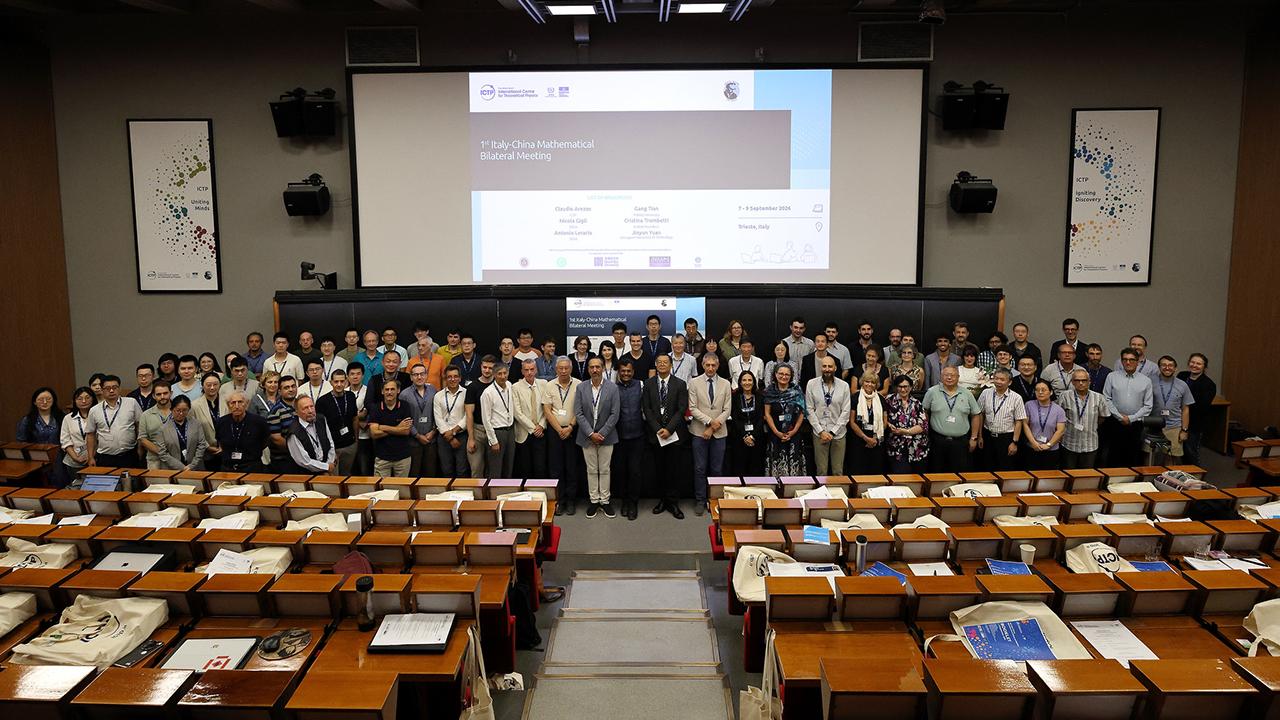
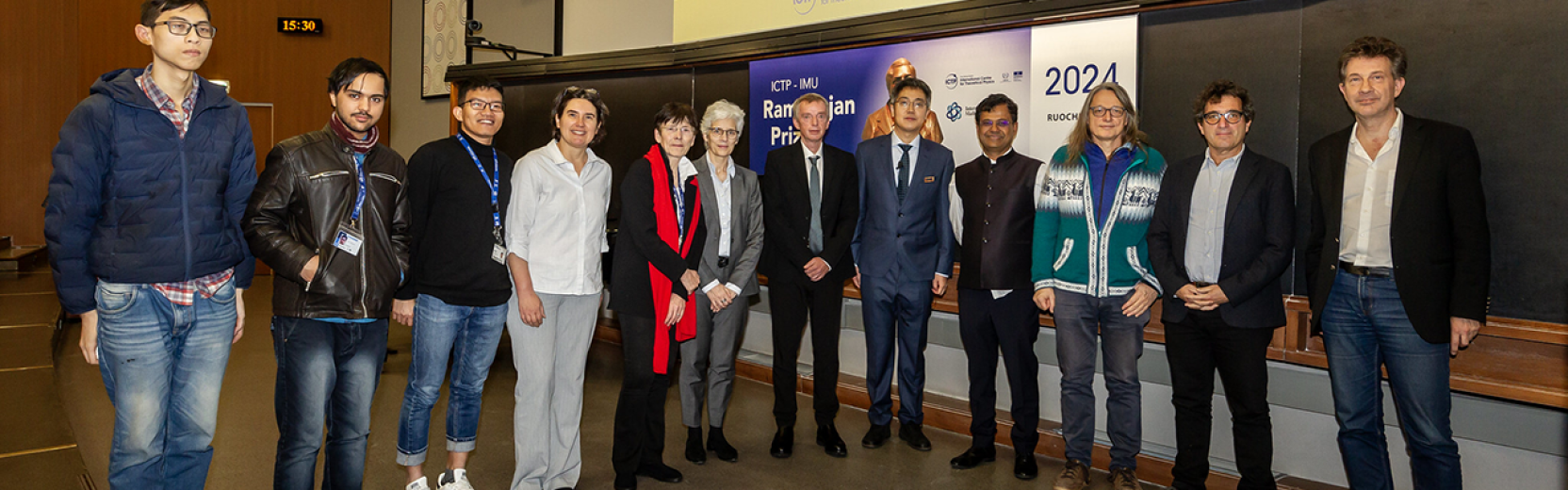
The Trieste mathematical community welcomed distinguished Chinese and Italian mathematicians from 7 to 9 September 2026 for the inaugural Italy-China Mathematical Bilateral Meeting at ICTP. Supported by the Chinese Embassy in Rome and endorsed by the Italian Mathematical Union, the three-day event was organised jointly with the Italian National Institute of High Mathematics (INdAM), the International School of Advanced Studies (SISSA), Peking University's Beijing International Center for Mathematical Research, Great Bay University, and Dongguan University of Technology, to strengthen joint research networks and explore new avenues for international exchanges.
The event’s opening ceremony was attended by Li Xiaoyong, Chargé d’Affaires ad interim at the Chinese Embassy in Italy. After highlighting Italy and China’s important past and recent contributions to mathematics, Mr. Li stressed the key role played by collaborations: “International exchange has always been an essential part of the development of mathematics. By engaging in dialogue and learning from one another, China, Italy, and mathematicians around the world can build on our shared mathematical heritage and contribute together to the advancement of modern mathematics,” he said.
The meeting aimed to foster new collaborations and partnerships between the Chinese and the Italian communities and to strengthen existing ones. “There are several areas of common scientific interest with mathematicians in China and already many ongoing collaborations,” said Cristina Trombetti, president of INdAM and one of the speakers at the round table on Italy-China mathematical collaborations on 7 September. “Every year, a significant number of Chinese students come to Italy thanks to the support of Chinese institutions and programs that fund their research stays abroad. What we would like to strengthen are exchanges in the opposite direction. It would be a great opportunity for Italian PhD students to spend a period of time in China, or even pursue joint PhDs under the co-supervision of researchers there,” she added.
The collaboration between the Chinese and the Italian mathematical communities has a long tradition. ICTP in particular played a pivotal role throughout the 1980s and 1990s in supporting and training young Chinese researchers in physics and mathematics. “While ICTP continues to welcome many young scientists from China, the extraordinary advancements in basic sciences across China in recent decades prompted new, higher-level avenues of collaboration, a transition this meeting can definitely champion by strengthening connections with the Italian mathematical community,” said ICTP Director Atish Dabholkar. The Bilateral meeting took place just one week after ICTP announced the creation of the Narasimhan International Chair in Mathematics, awarded to Xiaohua Zhu of Capital Normal University, China, as part of an agreement with the Beijing International Center for Mathematical Research at Peking University, Nanjing University, the University of Science and Technology of China at Hefei.
To foster the scientific dialogue, the 1st Italy-China Bilateral Meeting also featured presentations on recent research developments given by renowned Italian and Chinese mathematicians. In addition to the more traditional topics spanning analysis, algebraic geometry, dynamical systems and partial differential equations, several presentations were dedicated to Artificial Intelligence and its role in mathematics research. Jiayu Li, a professor at the University of Science and Technology of China in Hefei, with strong ties to ICTP, commented, “The speakers of this conference are very high-level and I learnt a lot during these three days. Mathematics in Italy is very strong, especially in algebraic geometry and analysis, as it is in China. Both our communities can benefit a lot from closer collaborations.”