scientific activity
19
Oct
2026
06
Nov
2026
Earth System Physics
2026 ACCLIMATISE Huddle | (smr 4330)
Physical
Back
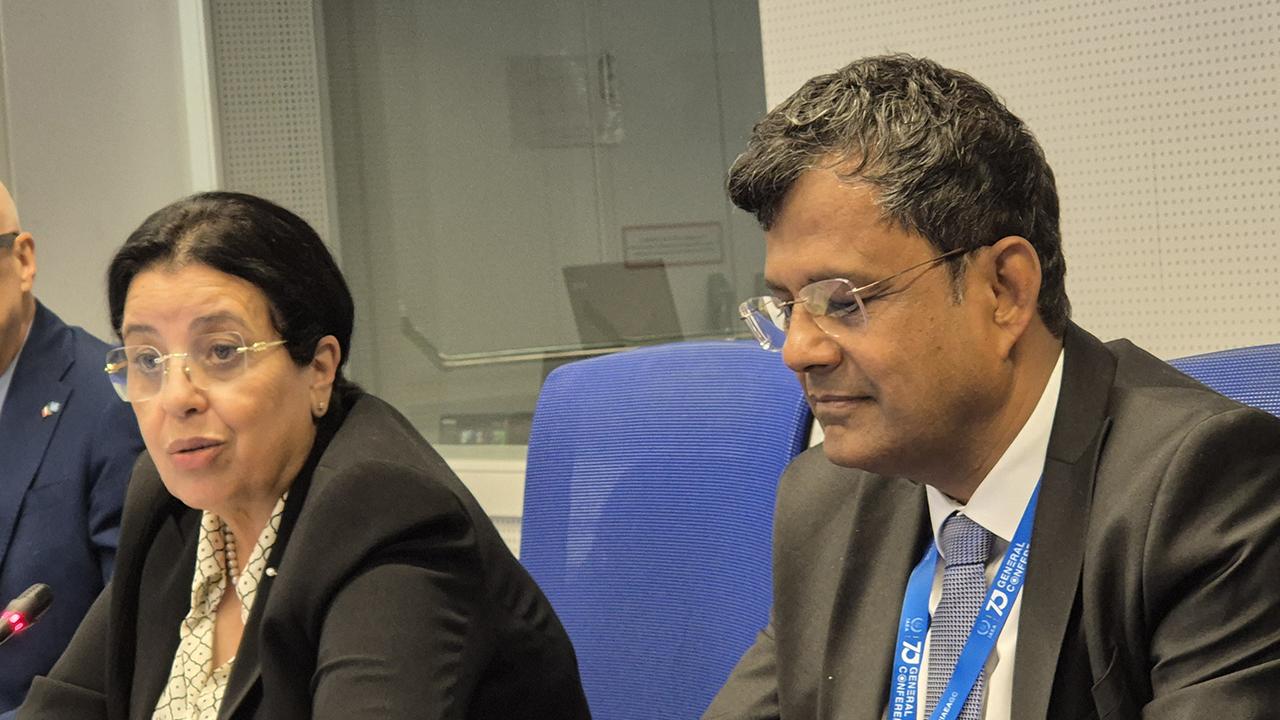
Top representatives of ICTP, the Permanent Mission of Italy to the International Organisations and the International Atomic Energy Agency (IAEA) gathered in Vienna on Monday 14 September 2026 for a special side event on ICTP at the 70th General Conference of the International Atomic Energy Agency (IAEA).
“More than sixty years ago, Italy, together with the then-young IAEA, helped turn into reality a pioneering vision: that scientific knowledge and the opportunities it creates should not be the privilege of a few, but a resource accessible to all.” Debora Lepre, Permanent Representative of Italy to the International Organisations, thus summarised ICTP’s mission and the key role played by Italy and the IAEA in its founding in her introduction to the special session, which was presented jointly by ICTP and the Permanent Mission of Italy to the International Organisations.
As highlighted by ICTP Director Atish Dabholkar in his remarks, ICTP and the IAEA have a long history of collaboration, dating back to the early 1960s. Working jointly and with the support of Italy, over the years ICTP and the IAEA have offered a variety of activities in support of research, education, training, and capacity building in developing countries. The special session titled “Building Technical and Scientific Capacity for Global Development and Research in Medical Physics and beyond: The joint effort of ICTP and the IAEA,” focussed on the Master in Advanced Studies in Medical Physics (MMP) programme.
Launched in 2014 as a joint programme between ICTP and the University of Trieste, with the support of the IAEA, over the years the MMP has attracted 254 students, half of them from Africa, one third women, most of whom have gone on to do life-saving work in their home countries, as highlighted by Ralf Kaiser, Senior Coordinator of Programmes and Advancement at ICTP.
Two students currently enrolled in the programme, Roberto Aparicio and Cherie Sisay Mekonen, spoke at the event and shared their personal experience and the impact that the programme is having on their careers. Aparicio is a first-year student from El Salvador. He became interested in medical physics after visiting a radiotherapy facility during his physics degree and decided to enrol in the ICTP Master’s in Medical Physics after finding out that only a few medical physicists in his country hold a master's degree in the field and all of them had been trained through the ICTP programme. “When I return home, I want to bring this knowledge back to El Salvador and help support the implementation of more advanced healthcare and help establish a master's programme in my country, so that we can become self-sustainable in this field,” he said.
Mekonen is a student from Ethiopia, one of the countries that contribute the most students to the Master’s. There, he serves as a lecturer in nuclear physics and as a researcher at Woldia University, but he decided to complement his training with more specialised training at ICTP. “I plan to join a hospital to apply my clinical experience in patient care while simultaneously pursuing a doctorate in medical radiation physics. Additionally, as a university lecturer, I am committed to returning to Ethiopia to share this knowledge with my students. I aim to improve academic curricula, train future physicists and advance radiotherapy capabilities in East Africa. The MMP represents not the conclusion of my journey, but the foundation of the next phase.”
The event was also the occasion to highlight two recent initiatives. The world’s first university master’s in radiation metrology was launched in January 2026 by ICTP and the University of Trieste with the support of the IAEA to address the lack of access to specialized capacity building for professional and research activities in the field, as highlighted by Mauro Carrara, Head of the Dosimetry and Medical Radiation Physics Section at the IAEA. Another new initiative that started shaping up at ICTP in Trieste during the week from 14 to 18 September was presented in a video message by Marco Esposito, Head of the Medical Physics Programme at ICTP. With the support of the European SocieTy for Radiology and Oncology (ESTRO), the American Association of Physicists in Medicine, Associazione Italiana di Fisica Medica, and the International Organization for Medical Physics, scientists are setting the grounds to launch a global collaboration in medical physics.
“What we have heard — from the global gap in medical physics and radiation metrology, to the history of this Master's programme, to the testimonials themselves — tells a single story more powerfully than any statistic could: this partnership works,” said Najat Mokhtar, IAEA Deputy Director General and Head of the Department of Nuclear Sciences and Applications, in her closing remarks. “The IAEA and ICTP have built a long-standing institutional and scientific relationship that speaks directly to both of our mandates. For the IAEA, ICTP is far more than a venue for training. It is a platform — one that turns scientific cooperation into education,” she added.
The event ended with the signing ceremony of a Memorandum of Understanding between ICTP and Women in Nuclear (WiN Global), a non-profit organization of women working in various areas of nuclear energy and radiation applications. The MoU was signed by ICTP Director Atish Dabholkar and Melina Belinco, President of WiN Global. Under this new partnership, ICTP and WiN Global will co-host joint events and workshops, support mentoring and networking, and collaborate on areas of common scientific interest, such as medical physics and nuclear medicine.
ICTP was represented at several other sessions of the IAEA’s 70th General Conference. On Thursday 17 September, Sandro Scandolo, ICTP Senior Coordinator of Research, gave a presentation on "Science Without Borders: ICTP’s Global Capacity-Building Initiatives" at the exhibit entitled “Nuclear Innovation & Research – Solutions for a Better Future,” hosted by the Permanent Mission of Italy to the International Organisations. Running over the entire week, the exhibition was launched in the presence of the IAEA Director General Rafael Grossi.