scientific activity
19
Oct
2026
06
Nov
2026
Earth System Physics
2026 ACCLIMATISE Huddle | (smr 4330)
Physical
Back
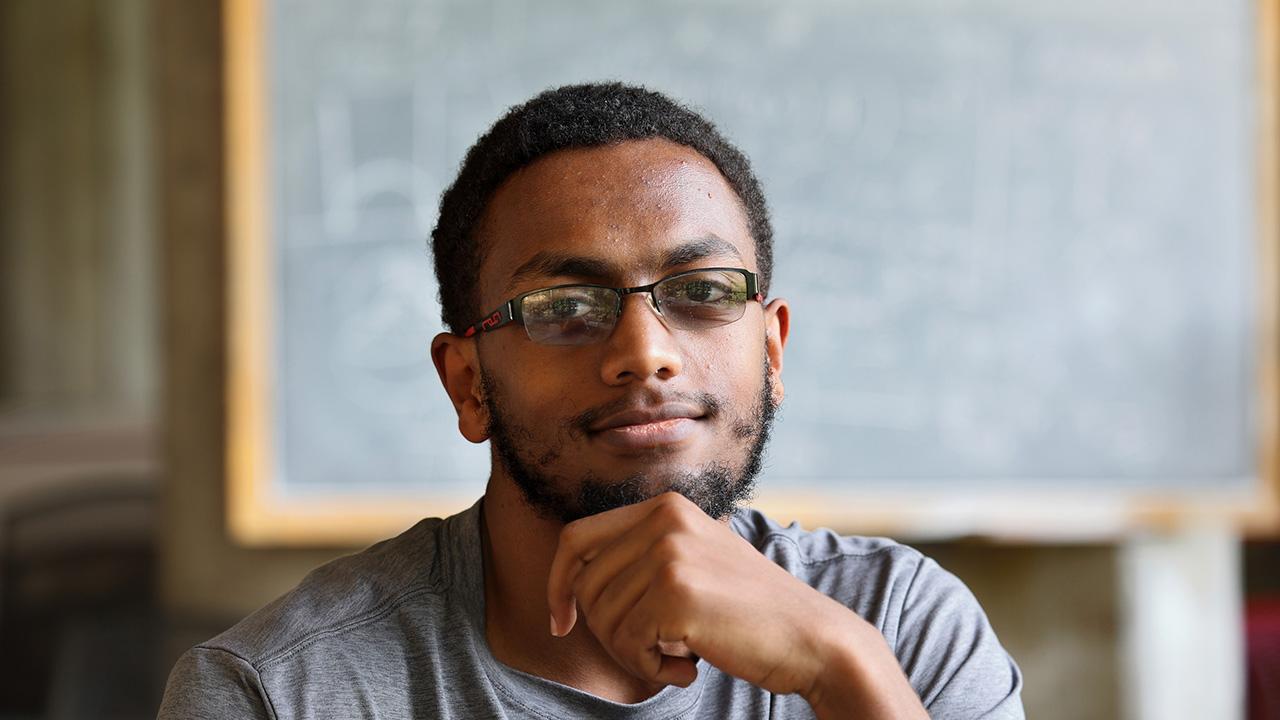
Until Covid-19 struck in 2020, Samuel Tegegn was a student in his second-to-last year of high-school, with no particular interest in math. But as the world was trying to adapt to a new way of living, and many activities could only take place online, internet connection became much more common in his city, Addis Ababa, Ethiopia, and he finally got access to it. “That changed my life,” he says.
A whole new world opened up to him. “I started seeing videos of people on YouTube who would talk about math problems that I could understand, but whose solutions involved advanced knowledge I didn’t have, and I realized that mathematics is this huge research subject and that there is a lot going on,” Tegegn explains. In addition to an internet connection, the pandemic also gave him a lot of free time that he spent exploring more videos about mathematics. “It was really surprising to find so many lectures available – some, I found out later, even by Fields medallists,” he continues.
That was also a time for big decisions. Once he finished high-school, Tegegn would have liked to access university courses in mathematics of the same level as those that he could find online, but when he checked what was available in his city, he was disappointed to see that they did not compare. “If I really wanted to pursue a career in mathematics, my only option was to get a mathematics degree in Ethiopia and spend my free time trying to teach myself the advanced mathematics that I was interested in,” he says.
And that is what he did. The courses at his university were not of the level he was hoping for, but along the way Tegegn found professors who were ready to help him and who gave him textbooks to read. “That was very helpful. Although it is true that there are many resources online, having someone to whom you can ask questions is much better,” he points out. He graduated with flying colours, but wishing that he could have learnt more from the classes he had attended.
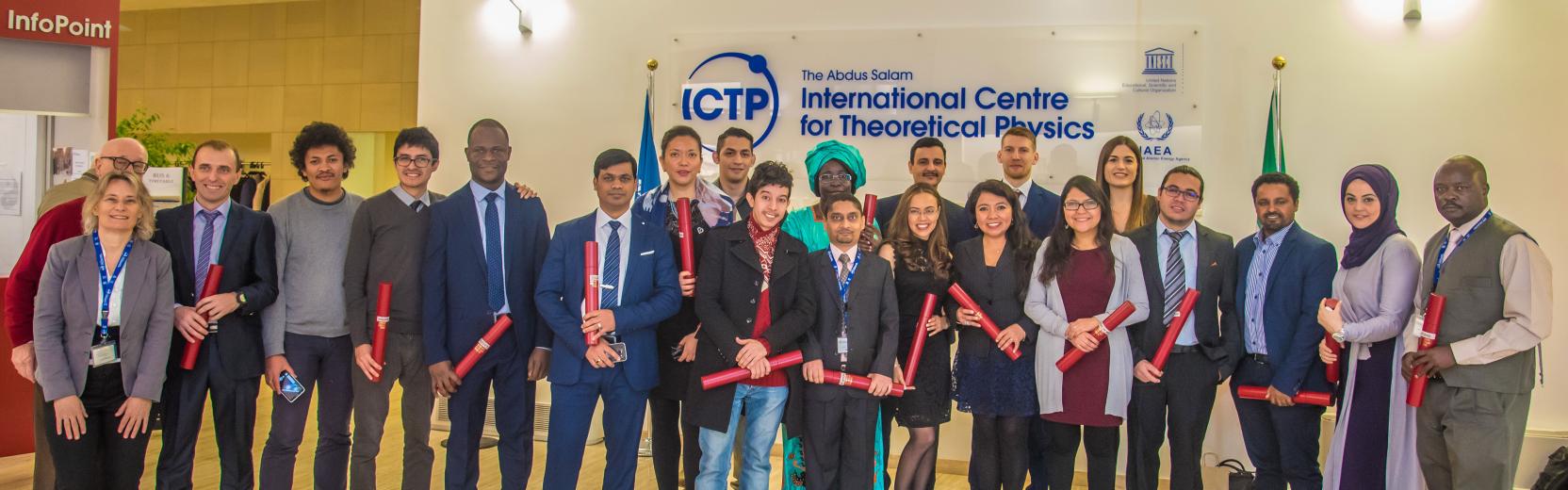
Tegegn’s online explorations are also what took him to ICTP. The Centre’s YouTube channel was among the ones he used to watch in high school, and where he found out about the ICTP Postgraduate Diploma programme. “The description said that it was designed to give students around the world who could not attend high-level universities access to some of the most advanced master’s and PhDs programmes. It suited me perfectly,” he says. To be admitted, Tegegn had to pass an interview. “It was a very friendly conversation about mathematics. Because I had not had many opportunities for this type of discussions until then, I remember it as a very pleasant moment,” he says.
At ICTP, Tegegn finally found the advanced lectures that he had been dreaming of for so long and a group of fellow students who shared his passion for mathematics. “We all come from different places, different continents even, but I have more in common with them than I have with many people in my own city,” he says, adding, “A valuable lesson that I learnt this year from someone at ICTP is that one needs to be at the edge of their comfort zone for change to happen.”
For his final Diploma project, Tegegn chose to work on a problem that brings together number theory and analysis, and that concerns the distribution of zeros of complex polynomials. As he explains, a polynomial in the complex field can always be factorized into the product of first-order factors. Conversely, if you take any set of points in the complex plane, it is always possible to find a polynomial that has those as zeros. “That is true until you start imposing constraints on the coefficients,” he says, adding, “For example, when you ask that a quantity called the “height” of your polynomial remains below a certain threshold, surprisingly you see that all the zeros tend to become equally distributed on the unit circle. Now I am trying to prove this formally.”
If any, Tegegn’s big passion for mathematics may have a small drawback: his interests are so broad, that it has been hard for him to choose what to specialise in. Next autumn, he will join the Berlin Mathematical School, a graduate school organised jointly by the mathematics departments of three major universities in the German capital. “I hope that this will give me the time to find out what I am most interested in pursuing,” Tegegn concludes.