
seminars
06
Oct
2026
High Energy, Cosmology and Astroparticle Physics
HECAP Seminar by Martin Lagares - Towards Integrability Beyond Flat Sp...
Physical
Back
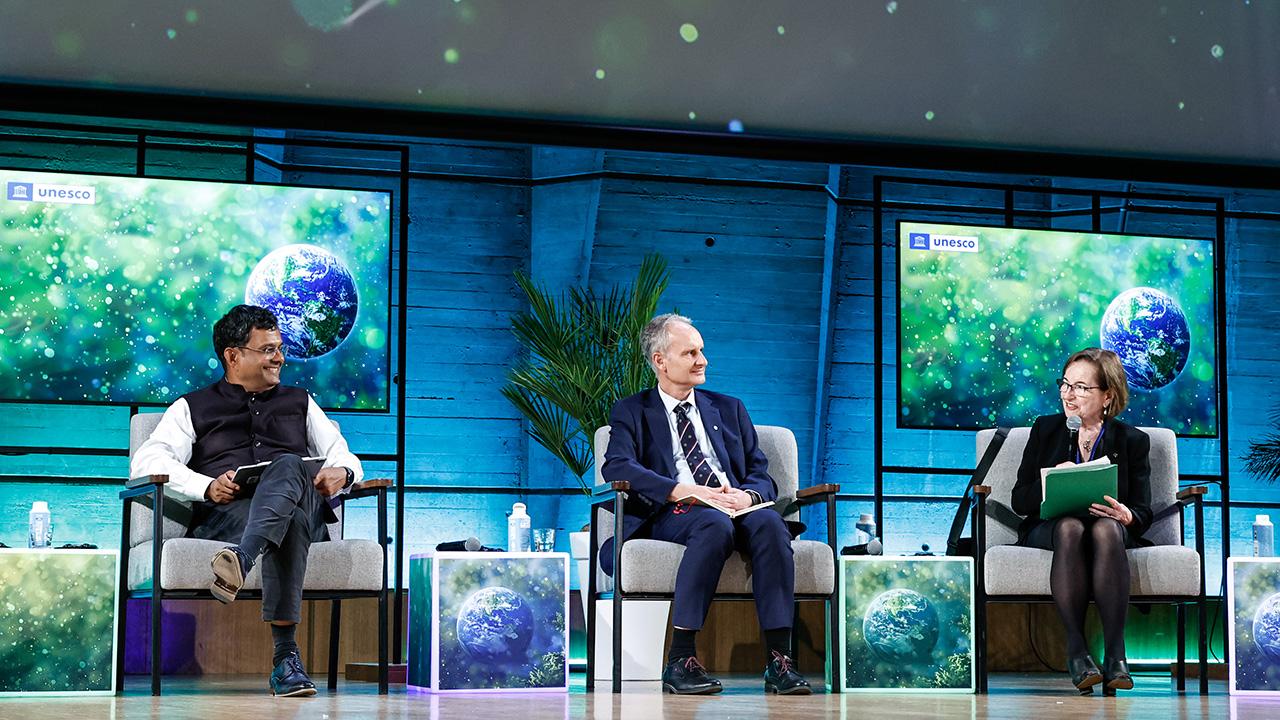
Two years into the International Decade of Sciences for Sustainable Development (IDSSD), UNESCO has convened the Decade’s first global conference to assess progress made so far and highlight science-driven solutions that address the Sustainable Development Goals. The conference took place from 15 to 17 July at UNESCO Headquarters, in Paris, and brought together ministers, scientists, and leaders under the theme “Science in action: Charting a sustainable and equitable future for all.”
The ambitious goals of this three-day conference were to accelerate progress towards the SDGs, shape priorities, and inform the strategy for sustainable development after 2030. “The challenge before us is to make sure that science is inclusive, trusted, open, and translated into meaningful actions for all people and for our planet,” said UNESCO Director-General Khaled El-Enany in his opening address.
ICTP Director Atish Dabholkar was a panelist in the session entitled “From Diagnosis to Action - Prioritizing Scientific Frontiers,” which closed the first day of the conference. The roundtable was meant to identify obstacles to action and examples of creative and effective approaches to addressing them. The discussion was an occasion to highlight recent initiatives put into place by ICTP, which are concrete steps to make science, including scientific computing and AI, inclusive and available to all.
“To put recommendations into action, we need a long-term view and strategic investments,” said Dabholkar as he introduced two pillars of ICTP’s new strategic plan, the International Consortium for Scientific Computing (ICOMP) and the International Science Alliance, as ways to create synergies among different partners and put them to the service of global science. ICOMP acknowledges the eminent role that computing and AI have been playing across all sciences and aims at bridging the knowledge and technological gap in these fields, while the International Science Alliance is a global network of scientific partners, with ICTP at its core, that will help the Centre enhance its impact across the world and help different communities in science to come together.
The start of the conference coincided with the release of the First Global Report of the International Decade of Sciences for Sustainable Development, which draws on almost 400 events and activities organised across 79 countries over the past two years. The report reveals broad mobilisation characterised by persistent divides, with only 10% of the Decade’s initiatives involving Africa, even though the continent contributes more than 17% of the world’s population. The report also identifies structural reforms needed to speed up progress towards the SDGs, including increased equitable access to scientific infrastructure and knowledge, making sure that scientists of all countries have the opportunity to benefit from and contribute to scientific discoveries, and to enhance inclusion and science literacy as keys to build public trust in science – all of which ICTP is working towards as part of its mission.