seminars
16
Oct
2026
Special Seminar: Evolution & Advances in Medical Physics in Healthcare
Physical
Back
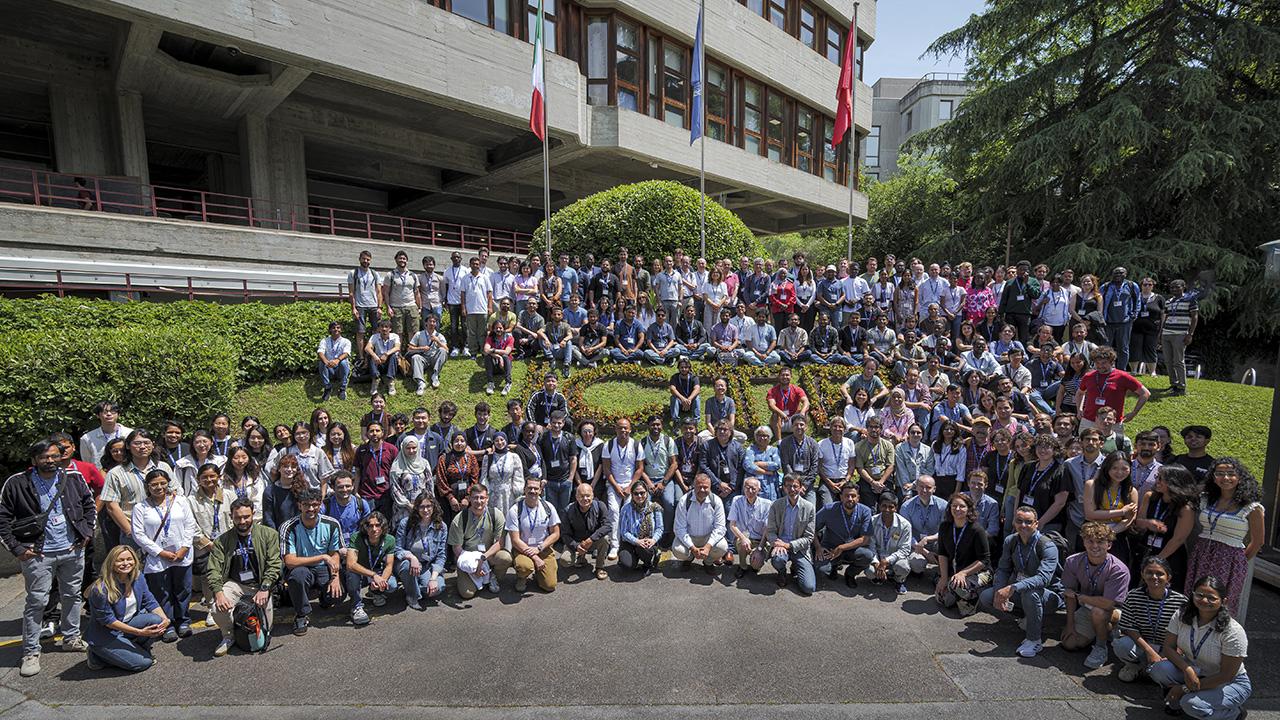
In June 2026, ICTP hosted a two-week school that has been among its most attended activities in the past ten years. Supported by the Swiss National Science Foundation (SNSF), the “Joint ICTP-MARVEL College on Materials Simulations in the Age of AI” was attended by about 200 participants of 51 nationalities, figures that are high even for ICTP. The school focused on computational materials science, a field that has grown rapidly over the years: according to a list published by Nature in 2025 and based on the Web of Science database, three of the ten most-cited papers of all time and across all disciplines were related to this topic.
Nicola Marzari, a professor at the Ecole Polytechnique Federale de Lausanne and at the Paul Scherrer Institut, and the Cavendish Professor at Cambridge University, was one of the school directors and main promoters. Having dedicated his career to the study and design of novel materials through computer simulations, he has seen this research field evolve over the years and can attest to its growing relevance and impact. “We always need new and better materials. So many of the technologies we enjoy every day rely on our ability to tune the properties of materials – from electric cars to portable electronics,” he explains. “Materials simulations have helped us do that in ways that have become more efficient and reliable over the years. Not only are these techniques very powerful, they have also become extremely accessible, to the point that anyone now could run these simulations on their personal computers (or even on their smartphones, as an alternative to browsing social content!). This makes these extremely democratic, and particularly relevant for a place like ICTP, whose mission is to create opportunities for scientists from all over the world,” he adds.
Marzari is the director of MARVEL, the Swiss National Centre for Computational Design and Discovery of Novel Materials, one of 48 National Centres for Competence in Research established by the SNSF between 2001 and 2026. This 12-year programme started in 2014 and the college organised at ICTP is part of the events that will mark its closure. “When we started thinking of a special training activity that would close MARVEL in 2026, we made it a priority to ensure participation from communities of young researchers who cannot afford to come to Switzerland at their own expense,” Marzari says, adding, “ICTP immediately came to mind as the natural partner of choice.”
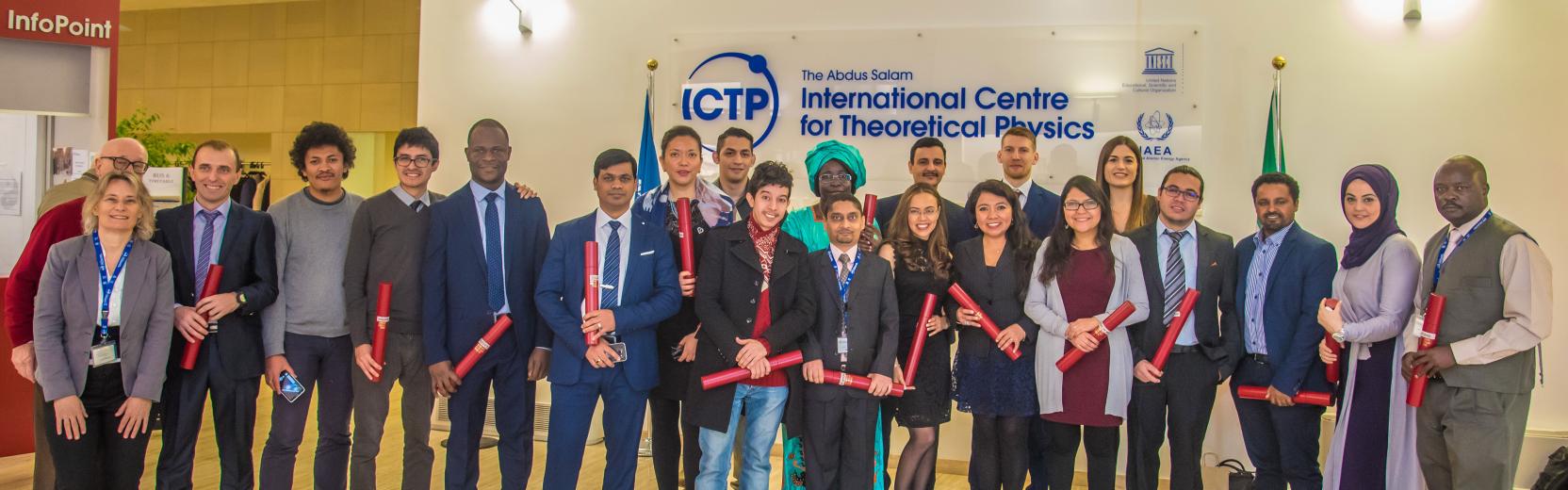
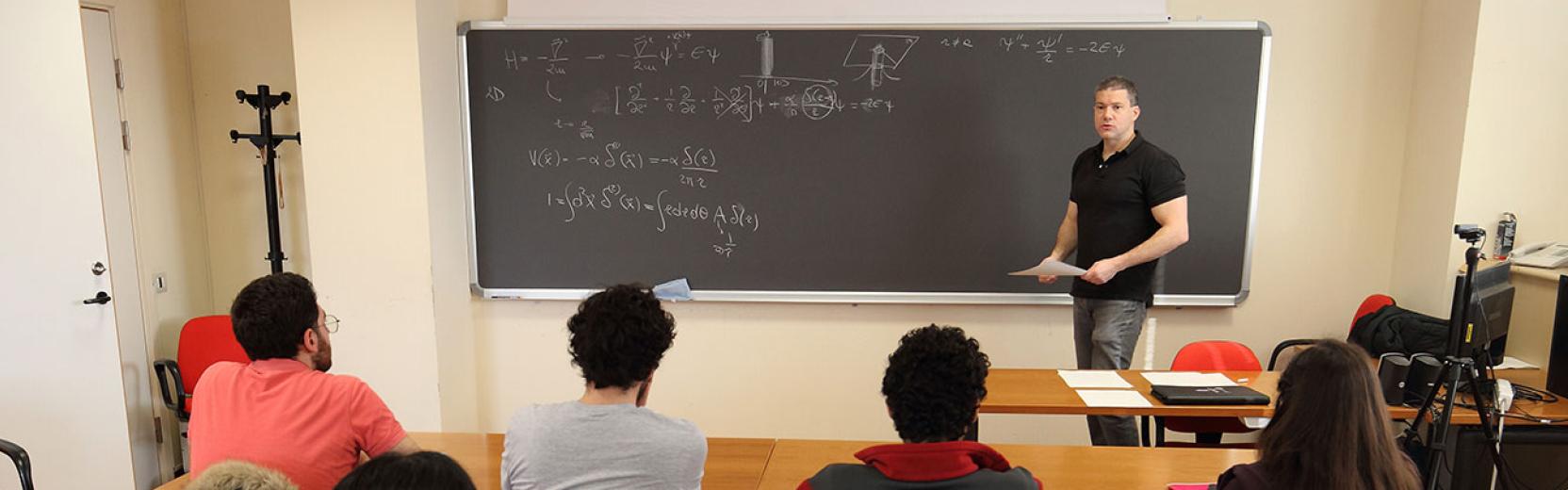
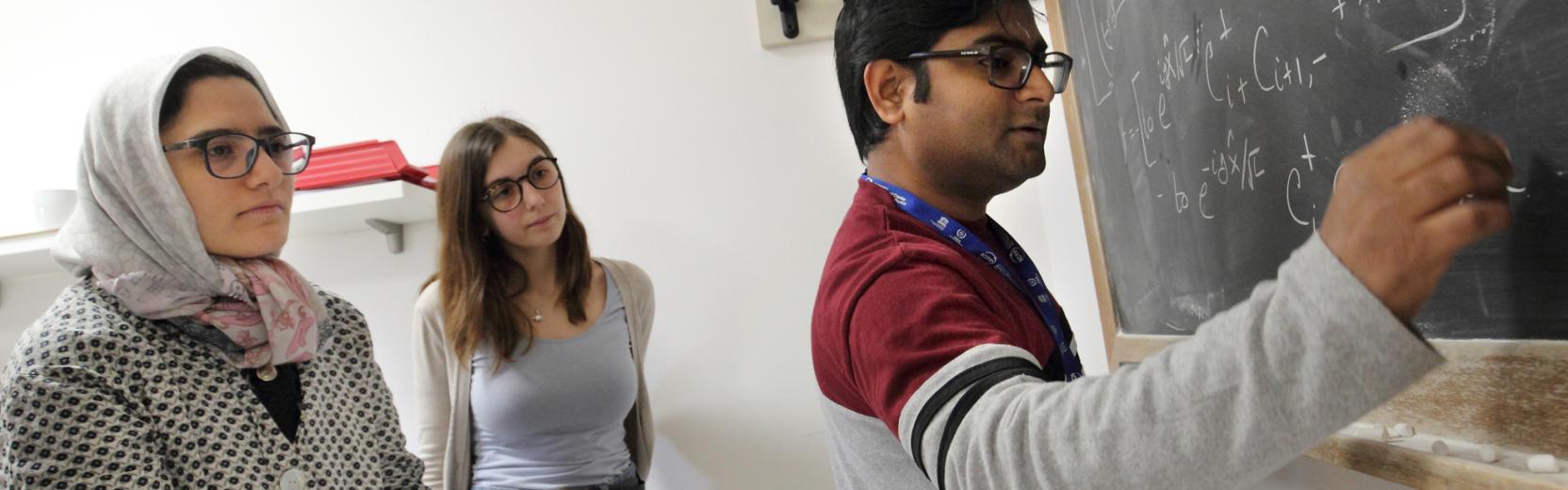
The joint ICTP–MARVEL college, which ran from 1 to 12 June, brought together graduate students and early-career researchers to learn state-of-the-art computational materials science, exploring how AI methods can complement well-known techniques. The first week focused on electronic-structure theory and spectroscopy, and the second covered statistical mechanics and atomistic simulation techniques, including new AI tools. The lectures alternated with hands-on sessions and open-mic discussions.
Thanks to the generous funding from the SNSF, 66 participants were given full fellowships to cover their travel, accommodation and hospitality expenses, and another 99 were provided with partial funding, excluding travel costs. “Many of the students would not have been able to come without such extensive financial support,” Marzari says. “My hope is that in a few years some of them will remember this school as the occasion that inspired them to pursue research in this field,” he adds. The actual impact of the school will be amplified thanks to the recordings of the lectures published online, something that MARVEL has done with all its training activities and conferences. “We want to leave the door open for the next Ramanujan. Maybe a bright and curious student will run into our lectures and learn materials science on their own,” Marzari says.
Judging from their reactions, the students and postdocs who had the chance to attend in person benefitted greatly from the college. “Learning directly from leading researchers behind the development of widely used codes such as Quantum ESPRESSO and Yambo was a special experience for me as a computational materials scientist,” wrote Salma Naimi from Morocco in a LinkedIn post. “The course was incredibly enriching, not only for the outstanding academic quality but especially for the warm community and the vast cultural exchange. It was an amazing experience to share this environment with over 200 PhD students, postdocs, and researchers from more than 50 countries,” wrote Ezequiel Luciano, a chemistry PhD student at the National University of Rosario, Argentina, in another post.
The joint ICTP-MARVEL college involved a partnership between ICTP and the Swiss National Science Foundation. This collaboration is a shining example of how ICTP can partner with national research agencies as part of an International Science Alliance that furthers ICTP’s mission to provide access to advanced training and research to scientists from all over the world. The partnership with the SNSF is also part of ICTP’s International Consortium for Scientific Computing, launched in 2024 with the aim of bridging the knowledge and technological gap in scientific computing at a time when rapid advancements in high-performance computing, AI and quantum computing risk increasing it.