

workshop
12
Oct
2026
16
Oct
2026
Career Development Workshop for Women in Physics | (smr 4312)
Physical
Back
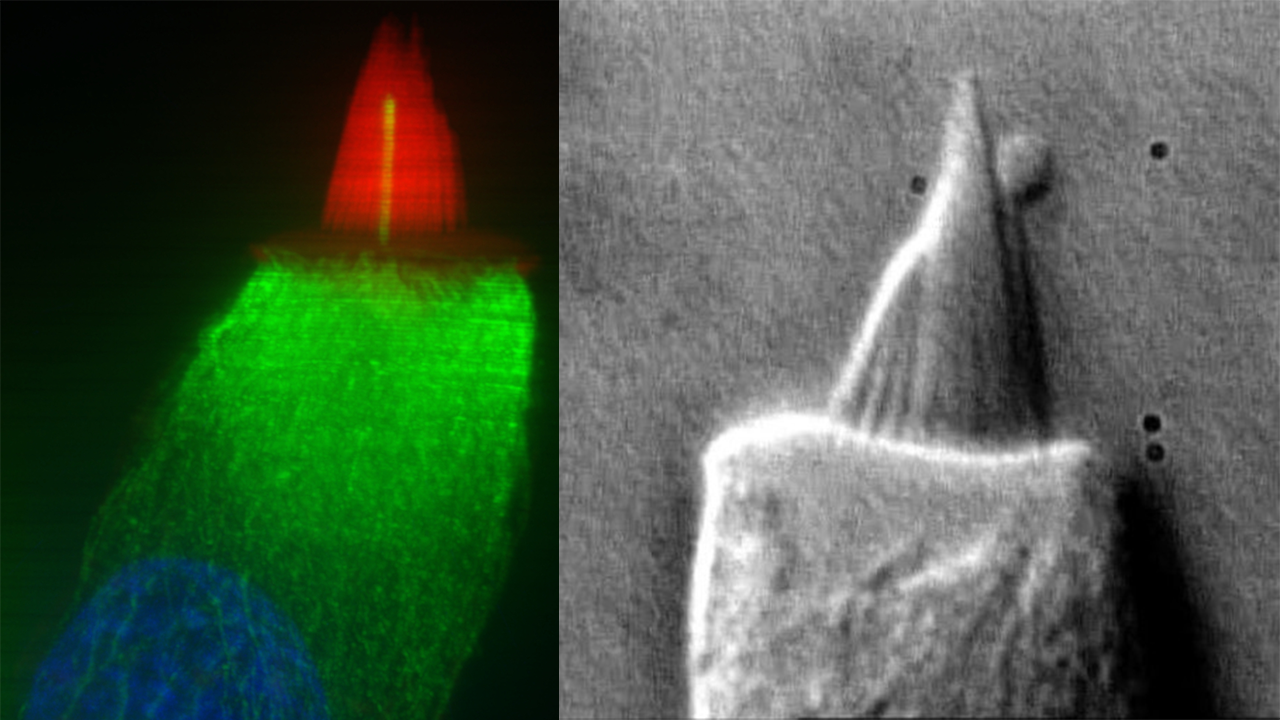
Our ears are sophisticated devices that can adapt to a wide range of intensities: from a whisper to a jackhammer there are about twelve orders of magnitude, and yet our hearing apparatus allows us to perceive both sounds and the full range of intensities in between. An essential role in this process is played by highly specialised cells in our inner ears, whose characteristic protrusions resemble hair and are therefore called hair bundles. A group of researchers in ICTP’s Quantitative Life Sciences section, and their international collaborators, have recently shown that these tiny organelles behave like complex and very versatile machines.
Located inside a liquid-filled, snail-shaped organ called the cochlea, hair bundles move in response to vibrations in their environment. The cells they are attached to, called hair cells, then transform information about their movement into an electric signal that goes to our brain. Contrary to human-designed antennas, however, these organelles can move spontaneously, without the need of external input power sources, and are therefore an example of what physicists call “active” systems.
ICTP research scientist Edgar Roldan has been studying for almost two decades active systems using stochastic thermodynamics, where systems are thought of as machines that exchange heat and work with their environment. When Roman Belousov, who is now a research scientist at the European Molecular Biology Laboratory (EMBL), joined ICTP to work with him as a postdoc, together they decided to apply the stochastic thermodynamics framework to study how hair bundles interact with their environment, and thus shed light on an essential sensory process in our bodies.
“The first step was to establish a correspondence with a thermodynamic machine,” Roldan explains. “We identified three different components that the hair bundles interact with: the external sound, which acts on the bundle like an external force; the surrounding fluid, which plays the role of a heat bath; and the active process through which the hair cell supplies the hair bundle with energy,” he adds.
To characterise the energy fluxes in the system, the team studied the motion of hair-cell bundles for different parameters of the external signal (its amplitude and frequency). “We could clearly identify four regimes, each corresponding to a specific type of thermodynamic machine,” Belousov explains. “According to our study, depending on the characteristics of the external signal, hair bundles can act as amplifiers, sensors, heaters, or—surprisingly—even as refrigerators,” he adds.
The team could also connect these regimes to different biological functions and quantify their efficiency. “We found that—exactly as one would expect—hair bundles behave as amplifiers when the amplitude and the frequency of the external signal are relatively low. In organisms, this function is carried out by the hair bundles on the outer side of the organ of Corti within the cochlea,” Belousov explains. “When instead the frequency and the amplitude are high, hair bundles behave like very efficient sensors and move essentially in response to the external signal, which is what hair bundles in the inner ear do,” he adds.
The study, which started out as theoretical, gained real-world relevancy through data obtained by James Hudspeth’s experimental lab at the Rockefeller University in New York. The group in the US tracked the motion of hair bundles in bullfrogs—a paradigmatic model system in research on hair cells. “Being able to work with actual experimental data allowed us to use relevant values for the parameters in our model, which was essential to identify regimes that are significant in real life,” Belousov explains. The team also collaborated with researchers at the University of Utrecht, in the Netherlands, to apply advanced machine learning techniques and extract the model parameters from experimental data. “By providing a thorough description of the different regimes in which hair bundles operate when triggered by an external wave signal, our work shows that they are very versatile and efficient machines,” Belousov says. The findings have recently been published on PRXLife.
The collaboration started in 2019 and it took some time before all the pieces of the puzzle could be put together. Belousov finished his postdoc while the project was still ongoing, and it became essential to involve other collaborators. An important role was played by Laila Saliekh, a student in ICTP’s Diploma Programme, who started working on hair bundles as part of her final project, in 2022. “In just three months, she helped us investigate the different regimes, and to characterise the efficiency of hair bundles,” Roldan explains.
“I feel lucky to have been included in this project. When Edgar presented it to me, I was surprised to discover that hair bundles could act not only as sensors, but also as amplifiers and heaters. The project immediately sounded very exciting and it turned out to be even more so,” Saliekh comments.
The article is dedicated to James Hudspeth, whose lab carried out the original experiments used in the paper. He passed away in 2025, as the paper was still under review.
Full article:
Thipmaungprom, Y., Saliekh, L., Alonso, R., Roldán, É., Berger, F., & Belousov, R. (2026). Thermodynamic signatures of sensing and amplification by periodically driven hair-cell bundles. PRX Life, 4, 013039. https://doi.org/10.1103/6wcm-z333