
seminars
16
Oct
2026
Special Seminar: Evolution & Advances in Medical Physics in Healthcare
Physical
Back
After more than a decade working with researchers from the Global South at ICTP, mathematician Fernando Rodriguez Villegas decided to turn some of his efforts to earlier stages of scientific formation. “By the time they arrive at ICTP to attend our Postgraduate Diploma Programme many students are already in their late twenties. In many developed countries, students progress more quickly,” he says, adding “Over the years I developed the strong sense that we need to start earlier.” As a continuation of his activity at ICTP, Villegas is striving to offer high-school students in South America early access to opportunities similar to those available to their peers in the Global North.
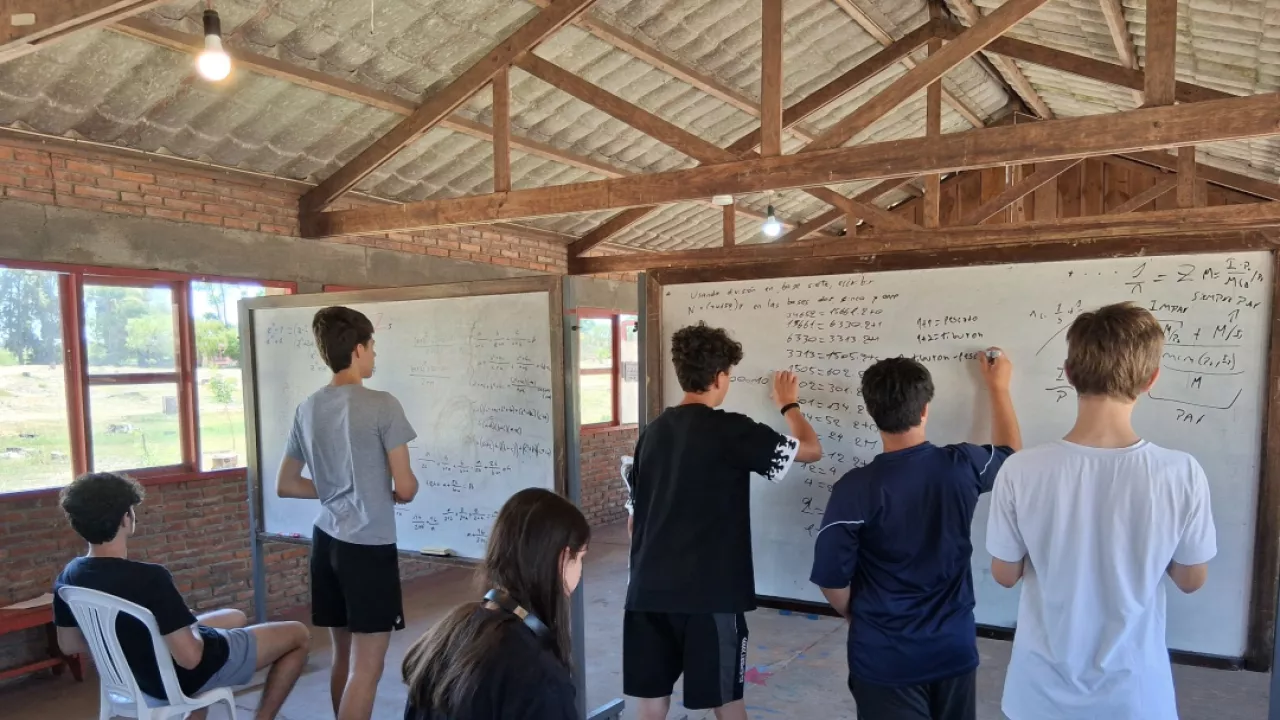
It was the conviction that it is never too early to be introduced to rigorous scientific training that led Villegas to imagine Inspira, a math summer camp dedicated to high school students in South America and aiming to bring them closer to mathematics. The first edition of the programme took place at the end of 2025 in Uruguay. Villegas co-organised the activity with his former PhD student Gonzalo Tornaría, now a professor at the University of the Republic, Uruguay. The initiative was supported by a private donor, thanks to whom all students could attend at no cost.
The programme took place from 8 to 18 December 2025 and it involved 20 students between the ages of 15 and 18. “This year only two of them came from outside Uruguay, but we would like this initiative to be an opportunity for young people from across all of South America,” Villegas explains. During the summer camp, the students met both experienced mathematicians who were responsible for the core part of the programme, and scientists from different fields, whose presence aimed to stimulate the students’ creativity and spark their interest in science. This edition included informal sessions with chemists, data scientists, and astronomers. “With the astronomers the plan was to look at the sky with their telescope, but there was a big storm and we ended up looking at a piece of meteorite, which sparked a lot of interest in the students,” Tornaría recounts, adding, “We learnt the first lesson for an observational astronomer, which is that you might well make plans, but the sky has got its own.”
“The real heart and soul of the programme were the counsellors,” says Tornaría, referring to the four undergraduate and master’s students of the University of the Republic and the University of Buenos Aires who volunteered their time to tutor the students and support the more experienced researchers in charge of delivering the lectures. “They worked a lot and with great enthusiasm,” he adds.
“If something like this had existed when I was that age, I would have gone immediately,” Villegas says. At Inspira, the students are encouraged to solve problems by themselves, with only minimal time dedicated to lectures. “We chose to focus on number theory because this research area requires little background knowledge before one can start tackling interesting problems,” Villegas says. “The specific content is not relevant, it is the process of discovery that we wanted the students to experience,” he continues. The inspiration for this approach came from the Programme in Mathematics for Young Scientists (PROMYS), founded in 1989 in Boston, United States, which pioneered a discovery-based approach to mathematical training.
The other important reference for Inspira was the Nesin Math Village in Turkey. “What I like about Nesin is the strong sense of community they create. In the village, everyone needs to participate in the various aspects of community life, including doing the dishes and sweeping the floors,” Villegas recounts. “It was important for us to make sure that at Inspira the students got to spend time both with professional mathematicians and with each other—to experience an environment where everyone shares an interest in mathematics.”
Inspira has only just started as a project and its founders are willing to try out different approaches to see what works best. Thanks to this new programme students across Latin America will have more opportunities to develop formal analytical thinking skills from an early age—something essential in a world increasingly shaped by Artificial Intelligence and advanced technologies. “We want to foster a collaborative environment and to invite young people to play with and be challenged by mathematics. No matter what they will go on to do in their careers, an experience like this, at a key time in their lives, will stay with them and hopefully help them in their future,” Villegas concludes.