
seminars
15
Oct
2026
High Energy, Cosmology and Astroparticle Physics
HECAP Seminar by Francesco Sciotti - Higher Point Positivity and Large...
Hybrid
Back

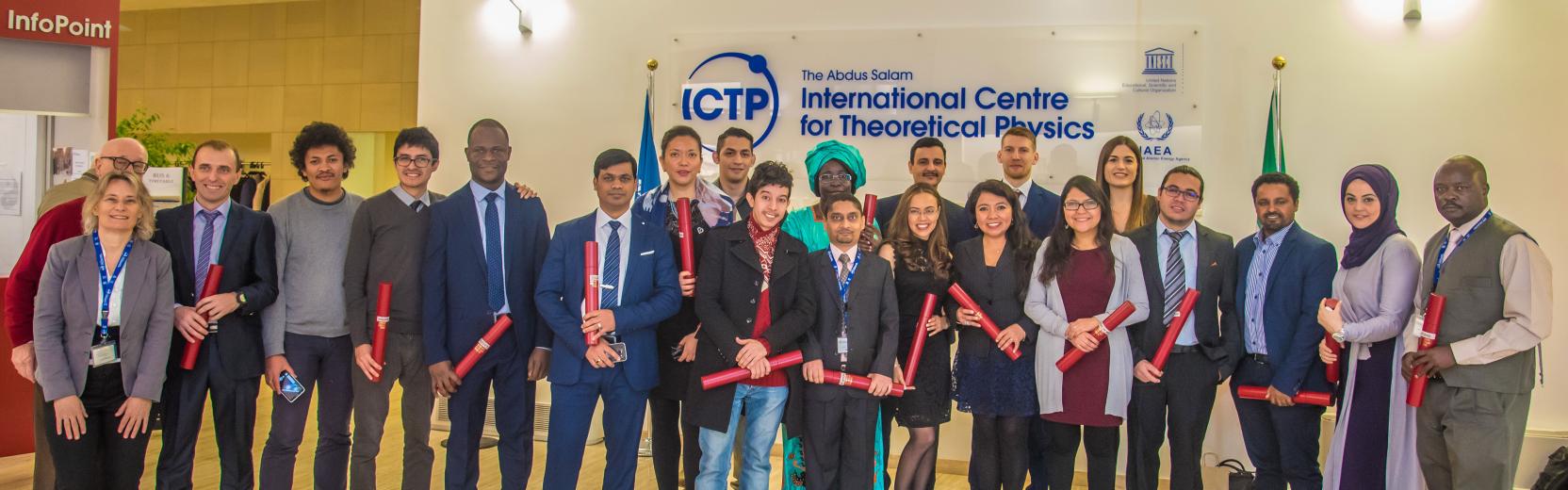
Since its founding in 1964, ICTP has served not only as a lighthouse for global science but also as a safe harbour for hundreds of scientists and students displaced by conflict.
In recent years, ICTP has assisted colleagues from Palestine, Ukraine, Venezuela, Sudan, Ethiopia, Yemen, Russia, and other countries in crisis.
Until now, ICTP's approach to dealing with these emergencies has been mostly reactionary and ad hoc, scrambling to pull together limited budgetary resources.
With growing geopolitical tensions and increased global conflicts, ICTP recognizes the urgent need for a dedicated emergency fund to assist students and scientists forced to seek refuge due to dangerous situations. By enabling displaced scholars to connect with global networks, attend international conferences, and continue publishing, this programme ensures they maintain their momentum at the most critical stages of their careers.
In the stories below, you will meet some of these remarkable scholars that ICTP has assisted over the years and see first-hand how a welcoming scientific community can change lives.
A researcher from Yemen arrived at ICTP in mid-2018, just two years after finishing his PhD. Because of the conflict in his home country, his future was totally uncertain. ICTP stepped in and hosted him as a postdoctoral researcher. This lifeline let him rebuild his research, join global networks, and publish his work in peer-reviewed journals. This led him to a role at the International Atomic Energy Agency (IAEA) and, eventually, to his current job at the National Metrology Institute of Germany (PTB).
A postdoctoral scholar from Ukraine came to ICTP in 2022 after fleeing the war, alongside her mother and two children. With institutional support, she was able to rebuild stability and return to research. She now continues her career as a postdoctoral researcher, with new publications underway and a growing international profile.
“Being fully immersed in the international community of ICTP... helped me go through the difficulties of being away from my husband and with my country at war.”
A Venezuelan researcher, after getting her PhD in Brazil, sought asylum in Spain. She faced very hard times—she was alone, had no place to live, and worked as an unpaid caretaker just to have a safe place to sleep. Her life changed when ICTP offered her a one-month visit, allowing her to restart her studies. She later joined ICTP's Master in High Performance Computing (MHPC) programme. Today, she has successfully rebuilt her career and works in the HPC department at Cineca, a major research centre in Italy.
“These lines are not enough to express how much I love ICTP and how big my gratitude is with this institution, which helped me not only to start my career again but also to stabilize my life in all senses.”
A graduate student from Sudan was facing tough legal and paperwork problems. He almost had to leave science just to find a regular job and stay in the country legally. A research grant from ICTP came at the perfect time and kept his scientific dreams alive. Today, he is doing a master’s degree in astrophysics and cosmology at the University of Trieste and has been awarded an ARDiS scholarship from the Regional Agency for the Right to Education.
“What you provided was not simply a research grant, but truly a lifeline at a critical and turbulent moment in my life. Remaining within the academic environment has allowed me to continue developing my knowledge and to build meaningful intellectual and human connections.”
A supportive environment does more than just help with jobs; it helps scholars find their confidence and their joy in research again.
A professor from Turkey had a very difficult and exhausting five years in his country. Things turned around when he was accepted as a visiting scientist at ICTP, spending two years under the "Scientists at Risk" program coordinated by Matteo Marsili. The trusting and free environment allowed him to focus on his work and support his family.
“What I came to understand more deeply during my time at ICTP is that humanity is not limited to blood ties, shared religion, or common nationality. It showed me that science is not only about knowledge, but also about hope, solidarity, and shared humanity.”
An assistant professor in computer science from Iran came to ICTP in November 2023 for a two-week training school. Instead, it was a turning point. Meeting global researchers and learning new concepts gave her confidence. She applied for the ICTP Associates Programme and is now continuing her academic career at a university in Italy.
“ICTP was not just a training course for me, but a transformative experience that helped shape and advance my professional path. Looking back, it reshaped my perspective, expanded my horizons, and gave me the confidence to pursue new opportunities.”
These stories reflect exactly what is at stake. Without support, many talented researchers risk losing not only their careers but their ability to contribute to global knowledge.
ICTP is working on establishing a fund to ensure resources are available when needed to help scientists at risk.
With your support, ICTP can ensure that brilliant minds are not lost to conflict—but instead continue to thrive, contribute, and shape the future of science.
How to Contribute
Donations can be made via the ICTP/UNESCO PayPal account here.
Donors interested in making a tax-deductible donation in the U.S. or Europe can contact abaldoni@ictp.it for additional information.