seminars
21
Sep
2026
Quantitative Life Sciences
QLS Seminar - Understanding long term eco-evolutionary dynamics in mic...
Physical
Back
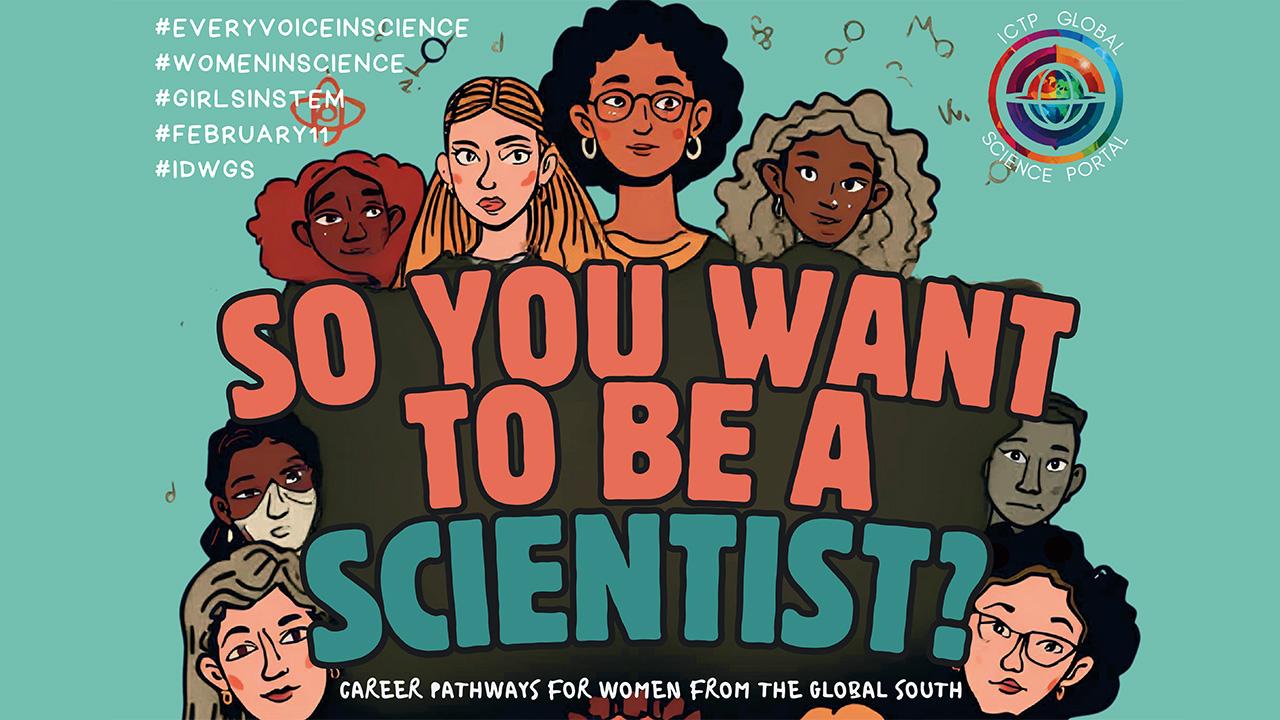
Are scientific careers now accessible to everyone? Despite initiatives to address the gender gap in science, female scientists still represent only one third of all researchers, and tend to have shorter, less-well-paid careers that their male colleagues. The situation can be significantly worse in emerging fields, with recent numbers showing women account for only 22% of professionals working in AI, and 80% of quantum companies reportedly lack any senior female figures. A trend of female underrepresentation in research, publications, and startups at most scientific career levels emerges, with some variations across fields and geographic region.
The United Nations' yearly International Day for Women and Girls in Science (IDWGS) on February 11 aims to raise awareness on these issues and encourage girls and young women to pursue scientific careers despite a lack of role models. This year, ICTP celebrates IDWGS with the ICTP Global Science Portal through an online panel discussion on careers for female scientists from the Global South. Three researchers: Lucía Mariel Arana Peña, Nana Geraldine Cabo Bizet, and Zainab Nazari from the ICTP network will share their experiences and ideas at the event, with physicist Kate Shaw, co-founder of ICTP's Physics Without Frontiers programme, as moderator.
The event will take place on 11 February at 3PM CET, to enable as many of our community to attend as possible.
We warmly invite everyone to register for the event at the following link: https://zoom.us/j/92907927561?wd=uQIufHrx0dQEuYvjbcsrVD5DKVSZtJ.1.
Please visit the public portal events page for more details: https://ictp.global/events/203085.
About our panelists:
Nana Geraldine Cabo Bizet is a professor at the University of Guanajuato, Mexico, and an ICTP Associate in the High Energy, Cosmology and Astroparticle Physics Section. Her research focuses on theoretical high-energy physics, with particular emphasis on the physics and geometry of string theory. She holds Bachelor’s and Master’s degrees in Physics from the University of Havana, Cuba, a Diploma in High Energy Physics from ICTP, and a PhD from the University of Bonn, Germany. She has held postdoctoral positions at the University of Guanajuato and the University of the Witwatersrand, and has been a visiting researcher at several international institutions. She has also presented her work at prominent international scientific events.
Lucía Mariel Arana Peña is a pioneering Guatemalan medical physicist whose career has opened new paths for women in STEM in her country. She earned her physics degree in Guatemala and completed an Advanced Master’s in Medical Physics at ICTP and the University of Trieste, followed by a PhD in physics in Italy. Now based in Estonia, Lucía works as a clinical medical physicist specializing in breast imaging at Tartu University Hospital, where she applies physics to improve cancer detection and patient care. Passionate about teaching, science communication, and advocating for women in STEM, her journey from the Global South to international clinical and research settings highlights the transformative power of education, global collaboration, and her commitment to inspiring the next generation of women scientist.
Zainab Nazari is a postdoctoral researcher at the European Brain Research Institute (EBRI) in Rome and a visiting scientist at the Scuola Normale Superiore in Pisa, Italy. Her research applies machine and deep learning to RNA sequencing, clinical, and proteomic data from neurodegenerative diseases and cancer. She obtained a Master’s in High Performance Computing (MHPC) from ICTP and SISSA and has a PhD in Theoretical High Energy Physics joint with Bogazici University, Turkey, and ICTP. As Zainab puts it, she managed to "quantum tunnel" through wildly different fields, from three-dimensional massive supergravity solutions to integrable models and simulations of phenomena in the early universe. Her research journey looks like a superposition of supergravity, integrability, and numerical relativity, through different phases.
Kate Shaw is an experimental particle physicist, working on the ATLAS experiment at CERN, and the Deep Underground Neutrino Experiment, Dune, at Fermilab. She is passionate about fundamental physics and data science, physics outreach and communication, and diversity and inclusion, and fostering physics worldwide. Kate is a scientist at ICTP, and a lecturer at the University of Sussex, UK.
ICTP's UN partner UNESCO will celebrate this year's International Day of Women and Girls in Science with a one-day event, taking place at its headquarters in Paris and online. More information and the links to register are available on the event's webpage.