workshop
12
Oct
2026
16
Oct
2026
Career Development Workshop for Women in Physics | (smr 4312)
Physical
Back
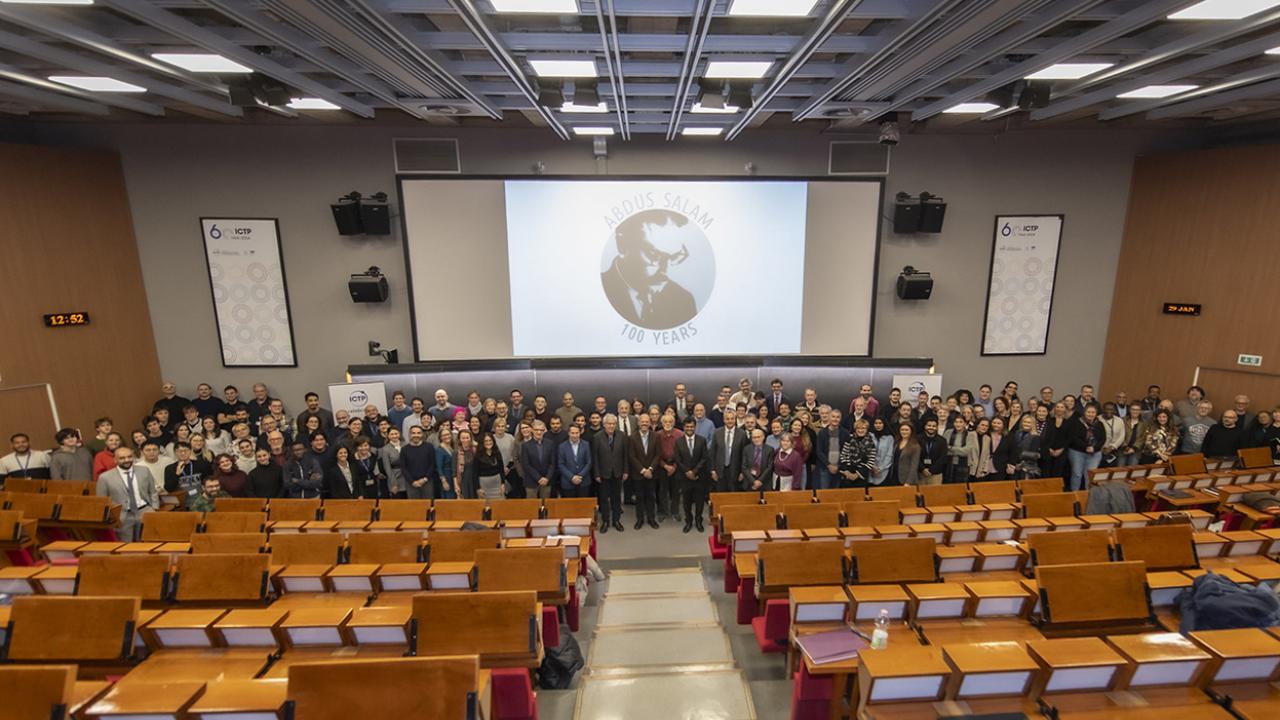
ICTP founder and Nobel Laureate Abdus Salam would have turned 100 on 29 January 2026. During the week of this important milestone, ICTP organized two events dedicated to quantum science, a rapidly developing field that many believe will take us to a new technological revolution.
Salam Distinguished Lectures by Peter Zoller and Ignacio Cirac
The first event to mark the week of Salam’s centennial was the series of four Salam Distinguished Lectures entitled "From Quantum Information to Transformative Technologies—A Journey of Remarkable Discoveries." The lectures took place from 27 to 29 January. This year’s speakers were two pioneers of quantum computing: Peter Zoller of the University of Innsbruck, Austria, and Ignacio Cirac of the Max-Planck Institut für Quantenoptik, Germany.
In his first lecture, Peter Zoller gave a historical overview of the main advancements in quantum information, including his and Ignacio Cirac’s first groundbreaking proposal on how to build a quantum computer using trapped cold atoms. Already in 1995, they were providing us with what Zoller called in his lecture “a complete package for universal quantum computing.” “Since the very beginning Ignacio and I were convinced that atoms and molecules could effectively be used as platforms for quantum computing,” explained Zoller, adding, “This was not at all obvious in the early days, but it has proved to be more and more true over the years. Many of the early ideas on how to build a quantum computer have survived to this day.”
Peter Zoller’s first Salam Distinguished Lecture
Zoller’s second lecture gave an outlook on some of the applications of quantum simulations and the opportunities they open. In particular, he presented a new paradigm for the design of materials with desired characteristics that combines quantum simulations with artificial intelligence in what he called “inverse quantum simulations.” Commenting on these new frontiers where research on quantum computing shifts from pure discovery to the design of possible applications, Zoller said: “There is a lot that we can do by leveraging machine learning and the quantum advantage for practical applications. This is where the field really leans on quantum technology and can lead to the development of devices that outperform classical computers.”
Peter Zoller’s second Salam Distinguished Lecture
Ignacio Cirac’s first lecture focused on quantum simulations as the most promising use of quantum computers. “We often hear that quantum computing will be a disruptive technology, and yet, if we could have a perfectly working quantum computer now, unfortunately we would not have many uses for it,” he said. “While these include specific mathematical problems such as factorization, optimization, and data analysis, we know that in all these fields a real quantum advantage will be reached only with high-precision quantum computers. Instead, quantum simulations are a field in which quantum computing can already give us a very significant advantage, and this makes them special,” he explained.
Ignacio Cirac’s first Salam Distinguished Lecture
Cirac’s second lecture was an introduction to the powerful formalism of tensor networks, through which the many-body quantum states that are used in quantum computing can be described in ways that are easier to handle computationally.
Ignacio Cirac’s second Salam Distinguished Lecture
Panel discussion on the future of quantum technologies
The series of events dedicated to quantum science and technology during the week of Salam’s centennial ended with a panel discussion on the opportunities and challenges of quantum science and technology.
Quantum experts from academia and the private sector discussed the societal implications of quantum technology and the need to raise awareness among non-specialists. Tommaso Calarco of the University of Bologna, Italy, and Forschungszentrum Jülich, Germany, highlighted the importance of involving different members of society in the decisions that will determine how quantum technology will develop and impact our lives. “Precisely because they are non-specialists, philosophers, ethicists, and people from all parts of civil society should be empowered to help us shape the future,” he explained.
Sabrina Maniscalco, CEO and co-founder of the quantum start-up Algorithmiq, said that awareness about quantum technology is also very important for the private sector. “We need processes at the board level that help decision makers to stay at the forefront of developments in quantum computing and technology, so that they can be ready to invest in these sectors when reliable quantum computers will become available,” she said.
Important efforts to communicate more broadly about these topics were made over the last year, as part of the celebrations for the International Year of Quantum Science and Technology (IYQ), proclaimed by the United Nations and celebrated in 2025. “The IYQ has encouraged outreach at various levels, including that of governments,” said Dragan Mihailovic of the Jozef Stefan Institute, the CENN Nanocenter and the University of Ljubljana, Slovenia, adding, “This initiative has had an important impact on policymaking, and we now need to make sure that this positive effect does not die away.”
In line with ICTP’s mission, the panel also discussed the importance of making quantum technologies available to those living in disadvantaged parts of the world. Asked how ICTP has contributed to closing the gap between rich and disadvantaged countries when it comes to quantum science and technology, Peter Zoller, who is also a member of ICTP’s Scientific Council, stressed the role of education. “The great thing about theoretical physics and now also about computing, is that it does not matter where you are, as long as you have the right training. Education and training are what can help us to close the gap and they are what ICTP has been doing and what makes it unique,” he said.
ICTP Director Atish Dabholkar also highlighted the International Consortium for Scientific Computing as a key pillar of ICTP’s strategic plan in his welcome remarks. The initiative, which counts both corporate and governmental partners, aims to ensure that access to computing—which is now crucial to scientific development and will soon also include quantum computing—be granted to scientists from across the world, including regions where the technological gap is greater.
In his introduction, Dabholkar also read a message by H.E. Anna Maria Bernini, the Italian Minister of University and Research. Minister Plenipotentiary Lamberto Moruzzi of the Italian Ministry of Foreign Affairs and International Cooperation, also gave his welcome remarks to the audience, alongside representatives of the Friuli Venezia Giulia Autonomous Region and several institutions of the Trieste Science System, including Area Science Park, SISSA and the University of Trieste.
Panel discussion “Opportunities and Challenges of Quantum Science and Technology”
ICTP is very grateful to the Kuwait Foundation for the Advancement of Sciences (KFAS) for generously supporting the Salam Distinguished Lectures and the panel discussion that followed.
As we reflect on how to ensure that the disruptive changes brought by rapid developments in quantum science and technology can benefit all, Salam’s vision for an open science as the collective heritage of humankind remains more relevant than ever and drives ICTP’s strategy for the years to come.