
seminars
17
Sep
2026
Quantitative Life Sciences
QLS Seminar - A primer in Gravity from Entropy
Physical
Back
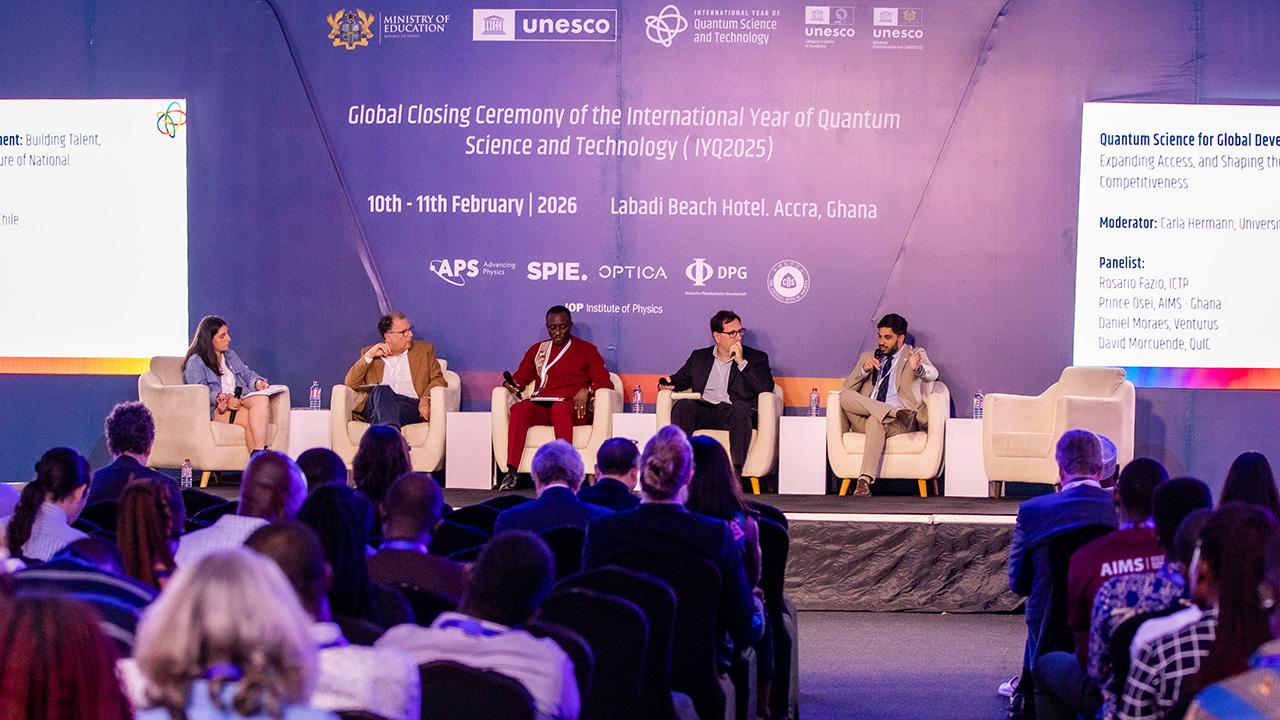
The International Year of Quantum Science and Technology (IYQ), proclaimed by the United Nations and celebrated in 2025, officially came to an end on 10 and 11 February 2026 through a closing ceremony in Accra, Ghana. ICTP Senior Research Scientist Rosario Fazio, who co-chaired the IYQ steering committee, represented ICTP at the closing ceremony, a two-day event that celebrated the end of a successful year marked by scientific and cultural events across the world and prompted reflection on how to ensure that the legacy of the IYQ will endure.
The choice to have the closing ceremony in Africa was meant to acknowledge the importance of Ghana in proposing the year. “Ghana was chosen because it led the efforts to get 2025 proclaimed as the IYQ by the United Nations,” said Joe Niemela, chair of the IYQ executive committee and ICTP emeritus scientist. He added, “There are many reasons why it is particularly relevant to focus on Africa. Not only did Ghana lead the effort to proclaim the year in the UN General Assembly but there is also a strong motivation to help ensure that Africa is not left behind in a deepening quantum divide.”
Featuring poetry readings, photo exhibits and performances by local artists alongside more science-focused discussions, the ceremony reflected the variety of the events organized throughout 2025. “Involving aspects of culture that go beyond science has helped us reach people outside the scientific community, and it is really in the spirit of UNESCO, the UN specialized agency that has led the celebrations,” Niemela says.
The programme of the event also featured two keynote talks given by Michele Dougherty, President of the Institute of Physics and the first woman to be appointed the UK's Astronomer Royal in the post's 350-year history, and Heike Riel of the German Physical Society and of IBM, who represents the industry sector. “Industry has been a key partner throughout the IYQ, and they have been driving the accelerating development of many quantum technologies over the past few years,” Niemela explains.
Five round tables were organized to establish the legacy of the IYQ and draw the way forward. ICTP featured in two panel discussions. On the first day, ICTP’s Research Coordinator Sandro Scandolo moderated the panel discussion on the future of Quantum Science and Technology in Africa, with speakers including former ICTP visiting scientist Nii Quaynor, a Ghanaian physicist and engineer known as the father of the internet in Africa, and Estelle Inack, an ICTP Diploma Programme graduate and former ICTP-SISSA PhD student, who is now a research scientist at Perimeter Institute.
Fazio took part in a round table focusing on education and training, where the panellists discussed how the much-hoped-for scientific and technological developments related to quantum science will become real only if generations of highly skilled scientists and engineers are trained.
Other panel discussions reflected on the legacy of the IYQ, the strategic priorities that will define the next decade, and the Open Quantum Institute—a Switzerland-led initiative joined by ICTP that aims to ensure equitable access to quantum computing.
The ceremony was hosted by the Ghanaian Ministry of Education, and a major role in making that possible was played by Riche-Mike Wellington, Deputy Secretary-General of the Ghana Commission for UNESCO. “Not only did he play a pivotal role in the processes that led to the UN General Assembly’s proclamation of 2025 as the International Year of Quantum Science and Technology, he also made this particular closing ceremony possible by involving the Ghanaian Ministry of Education after the Minister of Environment, Science and Technology died in a plane crash last August,” Niemela says, adding, “It was a tragedy for the country but also had consequences for IYQ, as we only had a few months left to organise the event.”
Niemela, who over the years has been actively involved in several similar UN-led efforts, including the International Year of Light, and the International Year of Basic Sciences for Sustainable Development, strongly believes in their lasting impact. “The involvement of the UN means that these initiatives are not only celebrations of science, they are also ways to tackle the problem of equitable development and education across the world,” Niemela explains.
“Quantum science and technology will be key to addressing societal challenges such as climate change, energy and health. These issues affect us all but get exacerbated in impoverished regions, where basic things like clean water, access to food and health care are lacking,” Niemela continues. “Technology could help us tackle many of these problems. Things like telemedicine, point-of-care devices, and lab-on-a-chip solutions can save lives, inexpensive LED systems are enabling students to study after dark in off-grid areas, and improved remote sensing and spectroscopy are aiding agriculture and food safety—they are all quantum technologies in action,” he adds.
But there is more: UN-backed initiatives for science are also ways to reach out to the general public and increase their awareness and trust in science. “During the pandemic we all noticed a lack of trust in science and how problematic that can be. Initiatives like these can help us raise awareness of how science actually works. In particular, it is the self-correcting scientific method that we need to promote, which ensures that the knowledge we build is not mistakenly characterized as ‘opinion’,” Niemela concludes.