seminars
06
Nov
2026
Mathematics
Seminar: Hypergeometric elliptic surfaces
Physical
Back

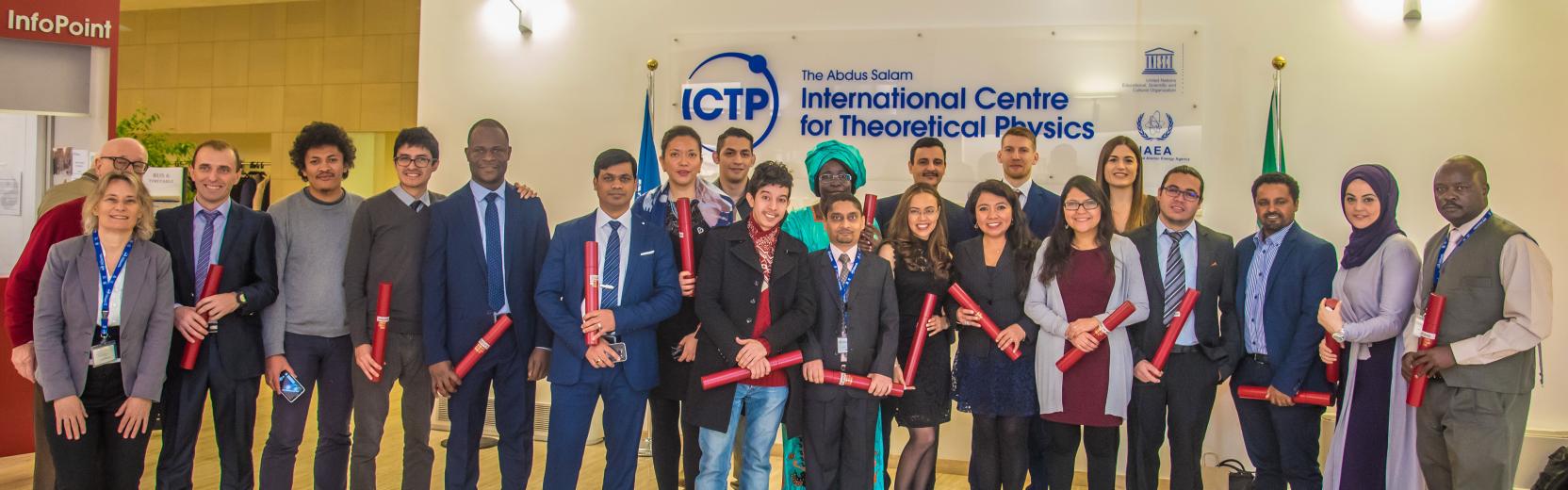
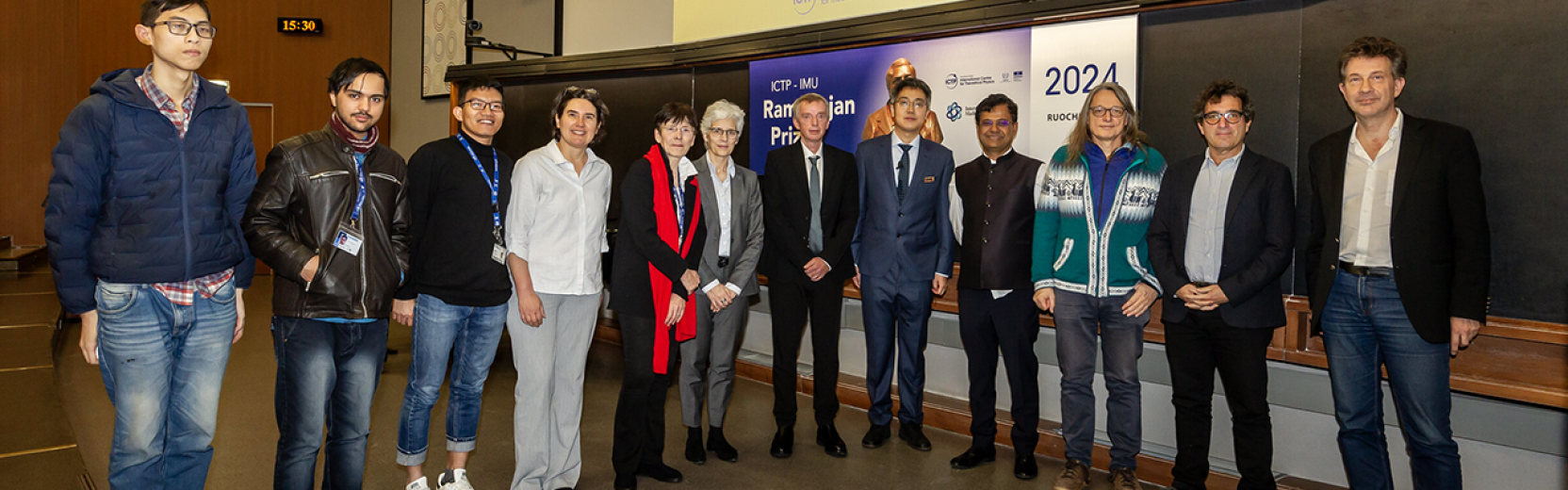
The 2025 ICTP Prize was awarded to Titas Chanda of the Indian Institute of Technology Madras, and Sthitadhi Roy of the Tata Institute of Fundamental Research, Bengaluru, India, at a ceremony on 21 October 2026 at ICTP.
The award recognised their contributions to the theory of quantum many-body systems, at the interface of condensed matter and quantum information science. We met them to learn more about their research and their personal reaction to being awarded the prize. Below we publish the interview with Titas Chanda.
Can you help us understand the problems that you work on, in simple terms?
Most of my contributions bridge two important areas of research: condensed matter, in particular quantum many-body physics, and quantum information theory. While quantum many-body physics has been a well-established research topic for several decades, quantum information theory is a younger but fast-developing field. It encompasses for example quantum communication and quantum cryptography. Over time, scientists working on these problems started realising that practical implementations of quantum information protocols would need to involve many quantum particles, whose understanding and manipulation requires condensed matter physics.
On the other side, people working in condensed matter physics understood that many concepts in quantum information theory can be used to answer questions on systems of many quantum particles. One such example is entanglement. This is a property described by quantum information theory, which tells us to what extent two systems are correlated to each other. Entanglement provides an alternative lens through which one can look at a quantum many-body system. It can help us characterise things like quantum phase transitions, different phases, and topological order very precisely. Therefore, one can say that quantum information theory needs many-body systems to implement quantum information tasks, while tools from quantum information theory provide a new lens on condensed matter systems. It goes two ways, and I am interested in both.
I am also interested in quantum simulations of many-body systems. Quantum simulators are synthetic quantum systems created in the lab, for example by using ultracold atoms trapped in an optical lattice. Experimental physicists can fine-tune their properties to ensure that their mathematical description mimics that of highly complex many-body systems in solid-state physics, which are very hard to study both theoretically and through classical simulations. One can then learn more about these complicated systems and verify theoretical predictions by using quantum simulations.
Recently I have also been working with high-energy theories that describe elementary particle interactions, but from a different perspective compared to traditional setups. My main objective here is to use tools and ideas taken from quantum information theory and quantum many-body physics to analyse and understand different aspects of these powerful theories.
What are some applications of your work?
As a theorist I work on problems that I find interesting and captivating, without worrying too much about applications, although I am confident that there will be applications that will be developed sooner or later. One example I can give is that of topologically ordered systems, which I worked on describing theoretically. It has been shown that they have very robust excitations, which is why scientists and engineers are trying to use them to build a quantum memory. However, I am not involved in this more applied part of the work. Another example of systems I studied that do have an application are many-body particle systems that can store energy and therefore could be turned into very tiny batteries. I worked on the theory, but it will be up to experimental physicists or rather engineers to see if this is really possible.
The biggest problem with the many-body quantum systems behind most quantum technologies is that they are very fragile. Entanglement in this context acts as a curse: because quantum particles are always entangled with their environment, quantum systems are never alone and therefore information quickly gets lost into the environment. Making a many-body quantum system robust against environmental noise is one of the biggest challenges in terms of applications, and it will take time, effort, and patience.
There is a lot of excitement about quantum technology at the moment, and I see a tendency to emphasise applications whenever quantum science is presented to the public, which makes it sound as if they will be available soon. As scientists, however, we know that there are still many limitations that need to be overcome and that there is a long way before we will be able to have a quantum battery in our phones or a proper quantum computer to do meaningful calculations.
AI is changing science. How do you use it in your work, if at all, and what are your thoughts about how it is transforming science?
When the first AI chatbot was made available at the end of 2022, I was a postdoc here at ICTP. As a non-native English speaker who did all of his school-level education in Bengali, I found it very useful, as it helped me proofread and improve my texts. Until very recently, that was all I used to do with AI. Lately, however, I decided to buy access to one of the more advanced tools, motivated by the enthusiasm expressed by some colleagues. I was surprised by the results. It is amazing what these tools can do. However, at the moment I don’t think that theoretical physics risks running into issues similar to those that we are seeing in mathematics. Problems there can be very well defined, while in theoretical physics defining an interesting research problem is part of the challenge and it requires human creativity. I do not expect AI to be able to design a good physics problem soon.
An issue that we are experiencing also in physics at the moment is that the number of scientific papers has blown up. A few weeks ago, there was an exceptional day when around 250 papers on quantum physics appeared on the preprint server arXiv. Although this was a one-off occurrence, the number of new submissions currently fluctuates between 50 and 100 on quantum science per day, compared to just 20-25 daily submissions during the same period last year. No one can keep up, not least the peer-reviewed publication system. While for a long time academia has been publication-driven, this is not sustainable anymore and the system will have to change, which might not be a bad thing after all.
After doing your PhD in India, you spent some time in Europe, first in Poland and then at ICTP, before going back to India to work there as an assistant professor. What did these experiences teach you?
The time I spent in Europe as a postdoc was extremely important for my research. That is when I started making many significant contributions, and I believe this was largely thanks to the opportunity I had to travel and collaborate with many researchers from around the world. When I was a postdoc in Poland, before the Covid-19 pandemic, for example, I had the opportunity to travel a lot, while the good thing about being a postdoc at ICTP was that I did not even need to travel because when you are here the whole world comes to you. We have many great research institutes in India, but one can still feel isolated there, because the country is so big and we do not always have the opportunity to travel because of teaching and administrative duties. I try to do that as much as possible because meeting with other researchers makes a big difference and new ideas can come up. That is my antidote against isolation.
What do you think ICTP has done best?
Academia in India is much more developed now compared to the past, but the generation before mine greatly benefitted from ICTP. For example, the first recipient of the ICTP Prize in 1983 was Ganapathy Baskaran, who is now an eminent professor at the Indian Institute of Technology in Madras. I heard him tell the story of how hard it was for him to do research before he visited ICTP and had the opportunity to meet top researchers and build a network of collaborators. The benefits and opportunities that earlier generations of physicists in India received from ICTP are immeasurable, and their impact has trickled down to our generation.
On the other hand, even though I did not benefit from it myself, I think that ICTP’s biggest contribution to science in the developing world more recently has been the Postgraduate Diploma Programme. I collaborated with some of the Diploma graduates, they are excellent. There are many talented students coming from developing countries who do not have the opportunity to study at a high level or work on cutting-edge research topics, and find a great platform here at ICTP. The Postgraduate Diploma Programme has become a treasure trove for discovering and nurturing exceptional young talents from developing countries, particularly among those from underprivileged backgrounds.
What does the ICTP Prize mean to you?
Being awarded the ICTP Prize has been overwhelming. All the work that I do also belongs to all my collaborators, who over the years have been very nice and generous to collaborate with me on different problems. I share this prize with all of them. It is also impressive to look at the stature of past recipients, who are very eminent scientists. In a way, I am very happy that soon the 2026 recipients will be nominated, so that I can step away from the spotlight.