seminars
29
Oct
2026
Mathematics
Seminar: Stark units for real quadratic fields and finite quantum dilo...
Physical
Back
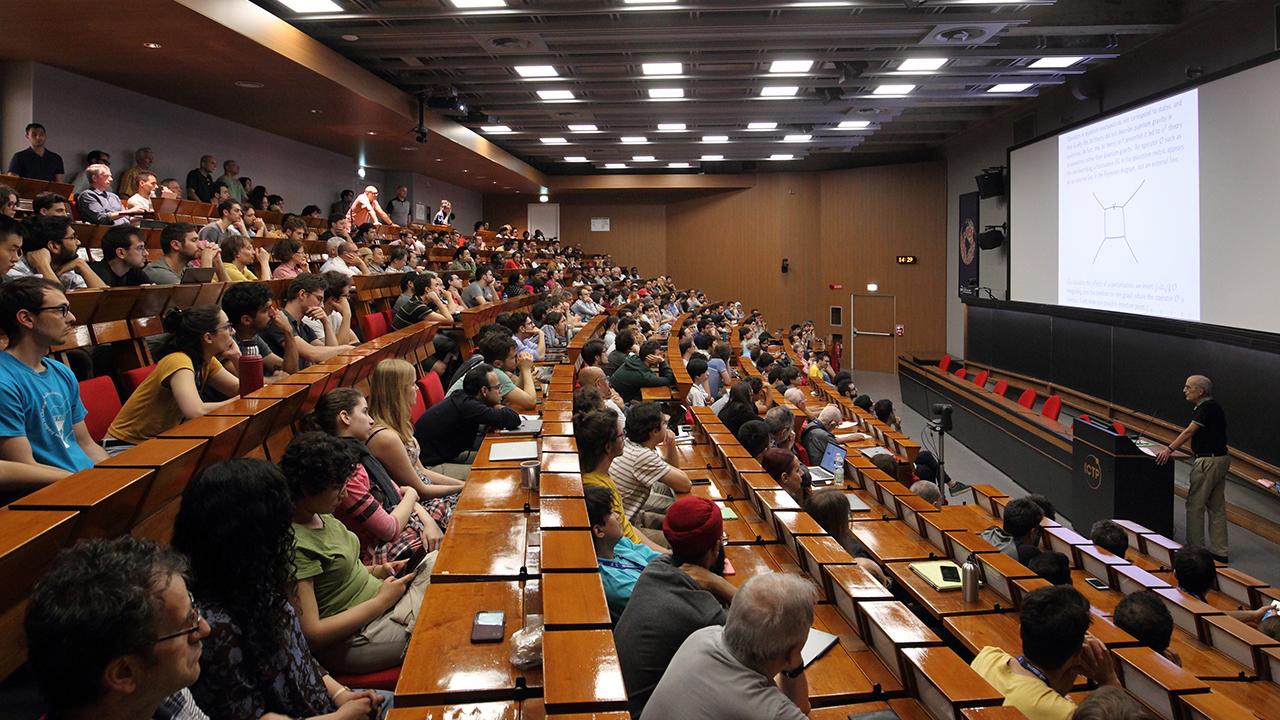
From predicting new protein structures to highlighting hidden patterns in data and solving difficult problems in mathematics, there are many ways in which Artificial Intelligence is changing how scientists advance knowledge. In addition to the exciting possibilities and new discoveries this will bring, there are also concerns within the scientific community, not least regarding the need to ensure that no one is left behind and that these advances benefit the scientific community at large. ICTP’s AI for Scientific Discovery Colloquia series will feature leading researchers from both the academia and the industry sectors sharing their most recent advancements in the field and discussing the future of science in the era of AI.
“As a statistical physicist, I study phase transitions, and I am excited to experience the one we are currently living with AI: scientific, societal, even philosophical. Recent Nobel Prizes and ICTP’s own 2026 Dirac Medal show how deeply physics and the foundations of AI are linked,” said Jean Barbier, ICTP research scientist in the Mathematics and the Quantitative Life Sciences sections. “AI can accelerate discovery enormously, but it can also widen the gap between those who have access to data, computing power and expertise and those who do not. Making sure this transition benefits scientists everywhere is exactly what ICTP was created for,” he added.
“Through this new colloquia series, ICTP aims to provide a realistic and scientifically grounded perspective on the state of the art of AI for science and science for AI research,” said Serafina Di Gioia, a postdoctoral researcher at ICTP. “The series will address some of the key challenges facing AI-driven scientific research, including the integration of physical knowledge into machine learning models, the interpretability and reliability of AI predictions, the ability of AI systems to generalize beyond their training data, and the potential of emerging approaches, such as scientific foundation models, to accelerate scientific discovery. Beyond showcasing cutting-edge research and successful applications, the colloquia will also critically examine the limitations of current methods, distinguishing genuine scientific advances from technological expectations.”
From materials science to mathematics and statistical physics, the colloquia on AI for Scientific Discovery will span a broad range of research problems where Artificial Intelligence is used as a powerful accelerator of discoveries or is itself the object of interest. “A central objective is to foster a constructive dialogue between AI researchers and scientists from different disciplines, encouraging the exchange of ideas and practices, identifying opportunities for interdisciplinary collaboration, and exploring how AI can contribute not only to faster computations and more accurate predictions, but ultimately to a deeper understanding of the physical world,” Di Gioia added.
The first colloquium in the series was given by Sebastian Ehlert of Microsoft Research AI on 14 October, and focused on several applications of Artificial Intelligence across materials discovery, molecular synthesis, biomolecular modelling, and electronic-structure theory.
Two more colloquia are scheduled to take place in 2026:
The AI for Scientific Discovery Colloquia series will continue in 2027 and is part of a whole year of AI-focussed scientific events organised by ICTP between the fall of 2026 and that of 2027. Other activities in the programme include the Salam Distinguished Lectures by Animashree (Anima) Anandkumar of Caltech, United States, in January, and the School and Workshop on AI for Emulation, Hybrid and Surrogate Modeling in Science in June.
The initiative is promoted by ICTP’s International Consortium for Scientific Computing, which aims to bridge the gap between the richest and the most disadvantaged countries in harnessing the potential of scientific computing to enhance scientific research.